One of the most powerful things about eCommerce is the ability to sell to customers all around the world. Yet one of the most challenging aspects of that is dealing with all the different currencies and the record keeping that comes with that.
Fortunately, Seller Ledger is excited to announce the availability of multi-currency support for eCommerce merchants.
The challenges
To help illustrate the financial complexity, let’s take the example of a North American Amazon seller. When you sell on Amazon to customers in Canada and Mexico, Amazon treats all of those transactions separately from your US-based sales. They issue payouts for those sales (minus expenses) in their native currencies. They also provide their “Activity reports” in those native currencies. This creates a couple of interesting challenges:
1. Reconciling payouts to bank deposits
Even though Amazon issues payouts in their native currencies, when they hit your bank account, you will see them show up in US dollars. But how do you know which deposit goes with the corresponding payout from Amazon? How do you reconcile a payout of $2,316.43 MXN to a deposit of $123.80 USD?
2. Reporting on your business in a single currency?
Even if you can figure out how to match foreign currency payouts to US dollar deposits, how do you look at a single profit and loss statement (or other financial report) that shows an apples-to-apples comparison of sales and expenses?
Automate your eCommerce bookkeeping with Seller Ledger.
How Seller Ledger handles foreign currency transactions
Seller Ledger now uses currency exchange rates to translate foreign currency amounts to US dollars. To see this in action, simply click into your account from the dashboard and scroll down to any non-US transactions, and you’ll see them in both USD and the original native currency underneath:
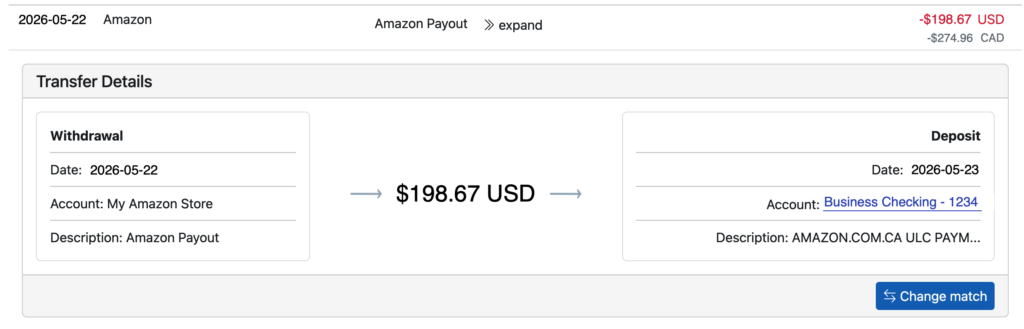
And when you find a payout, we provide you with even more details. Click “expand” next to a payout that you see in your marketplace account and you’ll see it matched to a deposit in your linked bank account:
What about differences from the exchange rate?
That’s an excellent question and we’re so glad we brought it up. Because exchange rates change all the time, and Amazon doesn’t provide the exact rate used at the time of each transaction, we use the daily “spot rate” to convert amounts from their native currencies to US dollars. And discrepancies end up going under a new category: Foreign Exchange Gain or Loss. This category rolls up to Line 27a: Other expenses on the Schedule C tax form. It will show as a negative number if you lost money overall on the conversion (and as a positive number if you were fortunate enough to benefit from the conversion).
As with many brand-new features, we have released this functionality in a “beta” status, meaning there may be bugs or edge cases that we don’t yet support well. But as with everything else we release, we make updates quickly based on customer feedback. So please let us know.
All included…at no additional cost
Unlike some other accounting platforms, who may require a higher tier to access multi-currency, raise prices frequently and STILL require you to use a third party connector like A2X in order to handle the reconciliation, Seller Ledger just handles it within the software, at the same price as your normal plan. No forced upgrades. No additional software subscriptions. Just a single, affordable solution. So decide for yourself which accounting software works best for Amazon sellers.
Ready to automate your eCommerce bookkeeping?
Join thousands of sellers who save hours every month with Seller Ledger.
This article will explain how accounting software providers receive eCommerce data, how safe it is for sellers to use, and how to think about choosing which provider to go with if you want to automate your eCommerce accounting.
Accounting Software providers such as QuickBooks, Xero and Seller Ledger use something called an API to import eCommerce sales data from online marketplaces such as Amazon, eBay, Walmart and Etsy. API stands for “Application Programming Interface.” They have been in existence for decades, and they are safely used all over the internet.
How Do APIs work?
Think of an API as a private way for software programs to talk directly to each other and exchange information. In addition to providing a standardized way to exchange data, most uses of APIs also include permissions to manage customer data privacy and security.
In the case of accounting software getting information from online marketplaces, the first step is for the accounting software to get approved as a reliable partner. The large marketplaces, with tons of customer data, don’t want just any software accessing their data. Once approved, each accounting software is issued what’s effectively a digital ID, which they can use to identify themselves each time they request information.
The next major step is making sure that the accounting software actually has permission to get data on behalf of an actual customer. In order to get this permission, the accounting software sends the customer to a special page to let the marketplace know what data they are permitted to share. This happens on the marketplace’s website, so no passwords are exchanged. Once the user gives permission, the marketplace sends the accounting software a token that can be used in future requests for data. Think of that token as a permission slip that the accounting software presents each time it asks for data.
Do all software providers connect with marketplace APIs in the same way?
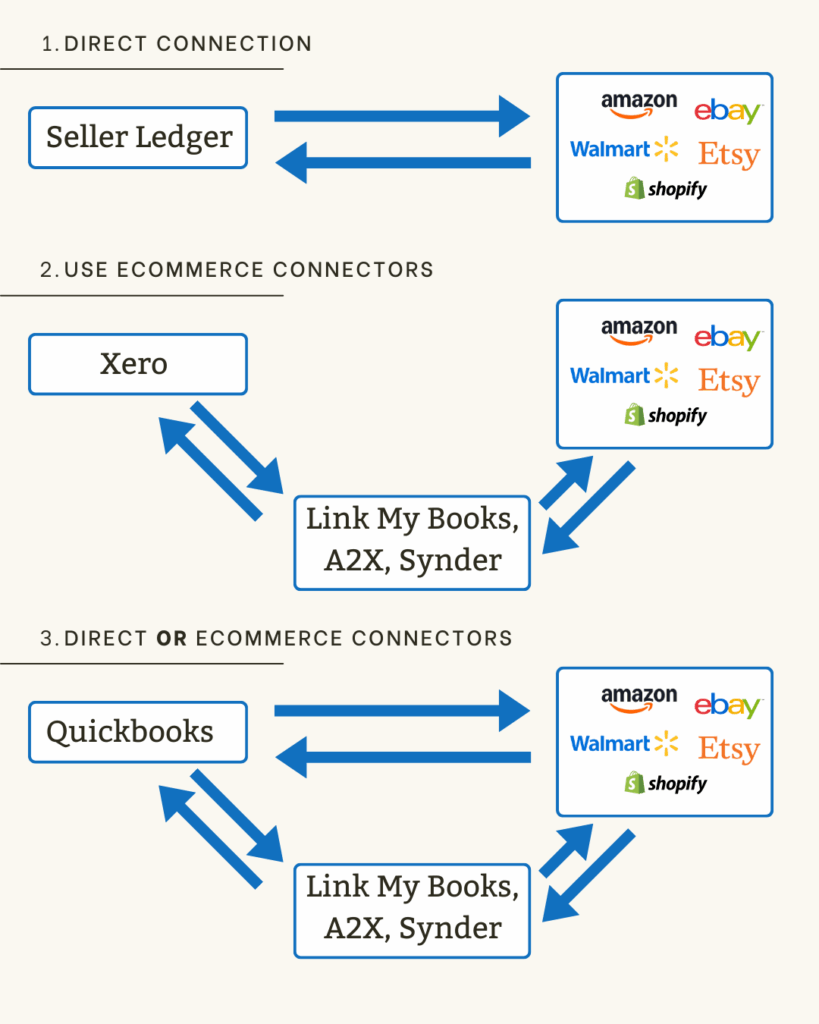
We’re glad you asked! No, they do not. This is one of the big differences in the various accounting software solutions for eCommerce sellers. Some accounting software companies connect directly to the marketplaces, others require the use of 3rd party eCommerce connectors like A2X Accounting, Link My Books and Synder. And some choose to offer both.
Below is a diagram showing the various options used by leading eCommerce accounting platforms.
Let’s talk about some of the advantages and disadvantages of each option:
Simplicity: Fewer moving parts means less work getting set up. And the connections and data are built into the core parts of the accounting software.
Lower costs: You don’t have to pay for extra software subscriptions.
Accountability: When marketplaces change their data, or introduce new fees, there’s only one party responsible for updating the software.
Cons
Less flexible: If your accounting needs are more unique, having the ability to choose between different methods of data connection (e.g. detailed vs summary) could be valuable.
3rd Party eCommerce connectors
Using 3rd party eCommerce connectors basically means an accounting platform is outsourcing the eCommerce data collection and classification to someone else. These 3rd parties specialize in eCommerce connectivity, so it’s a legitimate way to delegate responsibility. Xero has taken this approach.
Pros
Expertise of 3rd party connectors: The leading providers have been working with eCommerce Marketplaces for years, and are very familiar with the data.
Keeps books “clean and lean”: By delegating the task of collecting and summarizing eCommerce data, you can reduce the likelihood that your traditional accounting software gets bogged down by data it was never designed to handle.
Cons
Complexity: By using what some call “middleware”, you will have more setup to get things working as desired. And because the eCommerce connections are not baked into the core product, the user experience may feel disjointed.
Cost: Needing to use a separate software system will invariably cost more.
Choice of direct OR 3rd party connectors
Then there’s the option for maximum flexibility. Some accounting platforms build their own direct connections to leading eCommerce marketplaces, but also allow you to choose a 3rd party connection instead. QuickBooks offers this choice.
Pros
Flexibility: You can choose which option works best for your business, even doing it on a marketplace by marketplace basis if so desired.
Experience: In the case of using 3rd party connectors, these tools have been used together for many years by many sellers.
Cons
Quality and coverage: Based on online commentary, there may be issues with how well the direct connection tools are managed. And Quickbooks, as of the time of this post, only provides a limited set of direct integrations (e.g. they don’t connect directly to Walmart.) As such, you could end up with a “kitchen sink” approach.
Cost: If you use a 3rd party connector in addition to a multi-channel tier of Quickbooks, prices could get up there.
Conclusion
As with any decision, your choice of accounting software to use for your eCommerce business comes down to the needs of your business and your personal preference. But, regardless of which option you choose, feel confident that there are lots of ways to automate your eCommerce accounting using accounting software.
Ready to automate your eCommerce bookkeeping?
Join thousands of sellers who save hours every month with Seller Ledger.
They say imitation is the sincerest form of flattery. Well, here’s another form of flattery, though perhaps less sincere. We discovered yesterday that QuickBooks is buying Google ads against our product name.
We take that as a compliment, because it must mean that they would like to reach prospective eCommerce customers who are searching for us. That is quite flattering, considering they:
Are significantly larger than our company
Have been around a lot longer than us
Have had years (decades?) to try to enhance their software in ways that would make it work well for online sellers.
However, spending on advertising is a lot easier than simplifying an existing product that isn’t particularly well-suited to eCommerce. And we have faith that word will continue to spread about how much better Seller Ledger is for eCommerce accounting.
So we welcome the challenge – the challenge of competing with QuickBooks.
Ready to automate your eCommerce bookkeeping?
Join thousands of sellers who save hours every month with Seller Ledger.
Whether you’re thinking of switching or just getting started, this step-by-step guide will help you choose the right solution for your Amazon business.
Amazon (and eCommerce) accounting comes with a rather unique set of challenges, above and beyond traditional business accounting. In addition to regular income and expense tracking, you can expect to face:
Lots of order transactions (if you’re lucky)
Even more fee transactions
Inventory and cost of goods sold tracking
Reconciling platform payouts vs your bank
The good news is, with modern software, you can shrink the time you spend on accounting for your Amazon business from hours a month to minutes.
How do I choose?
First, let’s assume that you’d like to get your Amazon data into your accounting software with as little customization and setup as possible. That will rule out platforms like Wave Accounting and FreshBooks, which not only don’t have direct integrations with Amazon, but they require using a general-purpose API (application programming interface) tool like Zapier to make it work. That’s a non-starter for most sellers.
Next, the key question becomes – how much (and what kind of) Amazon data do you want to bring into your accounting software. Specifically, do you want all of the transactions from Amazon or just summarized information?
Detailed vs Summarized Amazon Data
So what does it mean, to get detailed vs summarized Amazon data? Let’s take a look at each method:
Detailed transaction data
This means pulling in every order, including line items, discounts, sales tax collected and remitted, shipping collected and fees subtracted. It also means bringing in shipping label transactions, and LOTS of other Amazon fees.
What are the pros and cons of this approach?
Pros:
You get a detailed understanding of your Amazon accounting, not only at the P&L and balance sheet level, but also down to the net profit on every sale (if your solution can pull that off – more on this later.)
You can automate inventory and cost of goods calculations by mapping sales back to the original inventory purchases.
You avoid the issue of payouts that can span different periods (e.g. an early January payout that includes both December and January transactions.)
Cons:
A lot of folks (especially old-school CPAs) worry about “cluttering up” your books with too much detail, which can bog down your accounting platform’s performance. Amazon does produce an enormous number of small transactions.
Reconciling all of those transactions to the payouts and deposits to your bank can be a royal pain in the neck if your solution doesn’t do this for you (again, more on this later.)
Summarized data
Using this approach, instead of bringing in all Amazon transactions, you summarize them outside of your accounting platform, and instead, match the totals to each payout that shows up in your bank account.
The pros and cons of this approach are pretty much the reverse of the above:
Pros:
Reconciliation of all of those Amazon transaction totals to your payouts should be easier.
You avoid “cluttering up” your accounting software with details you may never need to dig into.
The performance of your accounting software remains high by limiting the data you add.
Cons:
You miss out on net profit calculations.
You can’t automate inventory/cost of goods calculations.
Payouts that span multiple months or years are still problematic.
Biased perspective
We’d like to take a quick moment to point out the following observations. We believe two of the most commonly referenced reasons for choosing the “summarized” approach stem from folks dealing with practical limitations of existing solutions.
First, the idea that a lot of data will “clutter up” accounting software is more a reflection of the design of that software than the data itself. Good software design, especially around the user interface, can do an awful lot to hide details until you’re ready to look for them. In addition, when a software solution already has a lot of non-eCommerce features that already “clutter up” the interface, perhaps avoiding those unused features would help.
Second, the argument about performance is equally fascinating. There are many other platforms that process exponentially more data than accounting platforms and yet are still performant. Just ask Google, Amazon, eBay and Shopify (or TaxJar.) So changing your desired behavior because of the scaling limitations of a platform seems suboptimal.
What are the best options?
In addition to looking at the data options from Amazon, you may have some other criteria specific to you and your business. How much do you want to do yourself vs outsource to an accountant or bookkeeper? Do you want something specifically designed for eCommerce? How much do you value simplicity? Are you price conscious?
We’ll go through the leading contenders in the space, based on current (2026) sentiment:
Seller Ledger
Seller Ledger is one of the newer players in the space, created by several of the original team members behind Outright/GoDaddy Bookkeeping and TaxJar. It provides both the accounting platform plus a direct Amazon integration (as well as many others) and chooses the “detailed transactions” approach.
Seller Ledger is specifically designed for eCommerce sellers, so it has a much simpler user interface and setup process that traditional accounting software. It also has a pricing model that starts much lower and grows with the size of your business. Additionally, it does not limit features based on pricing tiers.
Detailed transaction approach
Seller Ledger pulls in all transaction data from Amazon via a custom-built integration. It does not require any third party connectors. And while it does pull in every Amazon transaction, it also ties every single transaction to each payout, and matches those payouts directly to your bank account deposit. This addresses the concerns about payout reconciliation, because it is built into the system, and also avoids the timing issue when a payout occurs around the end of a period.
It groups all transactions related to each Amazon order (including fees, shipping labels, etc) so you can see your net profit per order. That includes cost of goods sold, if you are using unique SKUs. Plus, it can automate inventory levels using the FIFO (first-in, first-out) method.
If you want to outsource your Amazon accounting completely, you can use Seller Ledger and invite your accounting pro to access your data. But bookkeeping services are not included in the price of the software.
Plans start as low as $10/mo for very small sellers and go up based on monthly transaction volume.
Limitations/concerns
As of the time of this writing, Seller Ledger is primarily designed for US eCommerce sellers. It handles US income and sales tax very well, and now provides currency conversion that works really well for North American merchants with sales in MXN and CAD. For sales in other countries, we provide report filters by native currency.
It is also exclusively designed for eCommerce businesses, so if you require invoicing or other features for service-based businesses, you may want to look elsewhere.
QuickBooks Online or Xero + third party connector
The most familiar names in accounting software, these two classic platforms support all kinds of business types, not just Amazon businesses.
QuickBooks is by far the most popular accounting platform in the market. It has a direct integration option with Amazon, though most commentary suggests using a third party connector (A2X, Link My Books, Synder) to properly handle Amazon data. It is also more recommended for US-based businesses. However, QuickBooks is also relatively expensive and is notorious for raising prices (as in, up 35% in the last 3 years as of this writing.)
Xero has no direct integration with Amazon, relying instead on those same third party connectors. It tends to be much more recommended for non-US businesses (especially anyone based in New Zealand or Australia.) And it is quite a bit less expensive than QuickBooks.
Now let’s look at the third party connectors. While there are a lot of more general purpose middleware solutions out there (e.g. Zapier, Webgility, etc,) we are going to focus on the 3 that appear to be the best tailored for eCommerce.
A2X Accounting is well respected for their data accuracy and working especially well with QuickBooks. They use the “summarized” approach to bringing in Amazon data, though they have a creative solution for splitting payouts across periods. They are said to be a bit more complex than other solutions, and more expensive.
Link My Books, which also uses the “summarized” data approach, focuses a bit more on ease of use and VAT compliance. It is also a bit less expensive than A2X Accounting.
Synder is a more broad-based connector, working not only with Amazon and other marketplaces, but also with payment platforms like Stripe, PayPal and Square. They also support the “detailed” approach to Amazon data in your accounting platform. They tend to be a bit more complex, which, given their extra capabilities makes sense. And their pricing is a bit higher.
The combos
Given the performance and “clutter” concerns, and seeing the US vs non-US focuses, it would seem like the choices really come down to:
QuickBooks + A2X Accounting (if you are US-based)
Xero + Link My Books (for non-US businesses.)
In both cases, you will be using the “summarized” Amazon data approach, with the pros and cons mentioned earlier.
Both combinations are also designed very well to work with accounting professionals.
In terms of pricing, QuickBooks Online + A2X Accounting is going to be on the more expensive side, at likely $100-$200/mo to start (depending on how many channels you link and transactions you process.)
Xero + Link My Books appears to start at about half that rate and go up from there.
One additional thought: by using two different applications, it might make for fun customer support inquiries if/when something changes or breaks. And given how often Amazon adds or changes their fees, software updates are inevitable.
Finaloop
Another relatively new option, Finaloop is a “full service” solution for eCommerce businesses looking for software + bookkeeping all in one place. Like Seller Ledger, they provide the accounting platform and a direct integration with Amazon, using the “detailed” data approach. And similar to Synder, they also link to other marketplaces and payment platforms. But their big claim to fame is that their service also comes with team members who will do your bookkeeping for you.
With pricing that starts at $250/mo, the base pricing isn’t that much more expensive than QuickBooks + A2X Accounting. But, prices rise pretty quickly and are based on your business revenue.
Limitations/concerns
Given what happened to Bench Accounting, another startup that tried to build a “software + bookkeeping” business (more broadly than eCommerce,) you’ll want to make sure you can take your data with you if needed.
Summary Comparison
Seller Ledger
Best for:
Small to mid-sized Amazon sellers in the US
Those who want detailed Amazon data
Those who want an affordable option
QuickBooks + A2X Accounting
Best for:
Larger US-based Amazon sellers
Those who want summary level data
Those willing to pay for quality/reputation
Already have an accounting pro that likes this combination
Xero + Link My Books
Best for:
Larger non-US based Amazon sellers
Those who want summary data
Those looking for a more affordable summary solution
Already have an accounting pro that likes this combination
Finaloop
Best for:
Amazon sellers who want to outsource their bookkeeping but don’t already have an accounting pro
Those willing to pay for that outsourcing
Those who want detailed Amazon data
Ready to automate your eCommerce bookkeeping?
Join thousands of sellers who save hours every month with Seller Ledger.
As we approach the end of our 3rd year since launch, Seller Ledger is announcing our pricing update for 2026.
Seller Ledger is increasing prices 0%
Yes, you read that right. We are keeping prices the same. Just like we did in 2025. And 2024.
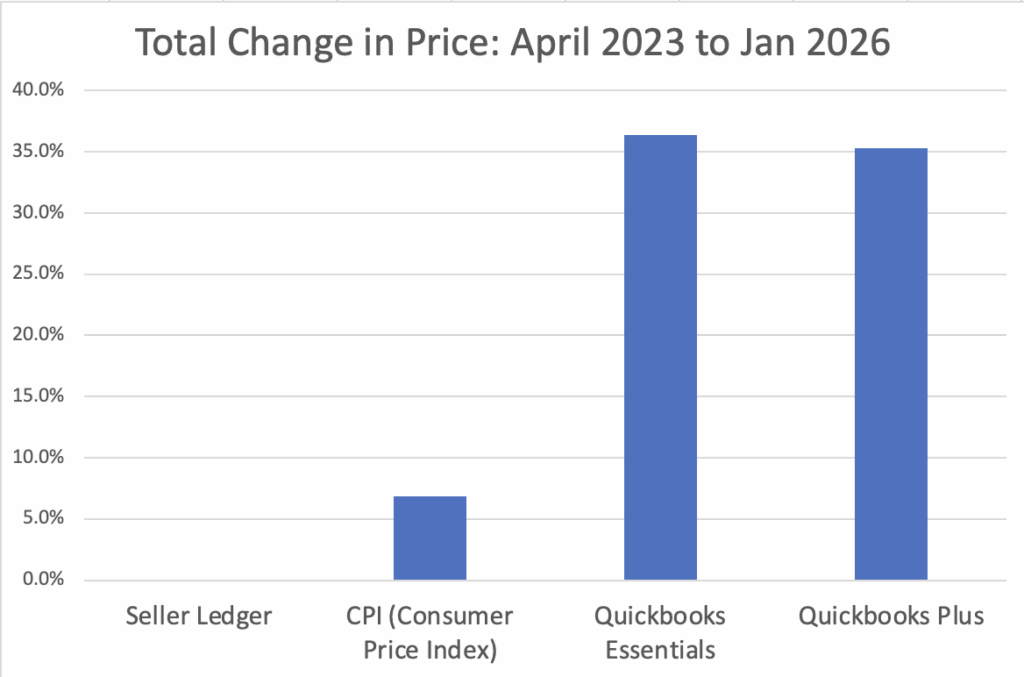
We haven’t raised prices since we launched on April 1, 2023. To put that in perspective, let’s look at a simple chart comparing us with the overall rate of inflation and the leading accounting platform: QuickBooks Online.
As you see, over the last 2 years and 9 months, the total rate of inflation has been 6.8%. We also included the change in price for QuickBooks Essentials, which allows for up to 3 sales channels but no inventory tracking, and QuickBooks Plus, which includes everything in Essentials plus inventory tracking. In both cases, their monthly prices have increased more than 35%, or 5x the rate of inflation.
Conversely, Seller Ledger’s monthly pricing hasn’t changed at all. Given the rate of inflation over that time, Seller Ledger has actually gotten cheaper relative to most other products and services.
And yet, we’ve added a TON of new functionality
Just look back at what we added in calendar year 2025. Click on any of the bulleted items to learn more.
Oh, and though we haven’t promoted it yet, those of you who still have to deal with sales tax returns might want to check out our new state sales tax reports under the “Taxes” tab.
If you want to go back even further to see what we’ve added since launch, feel free to check out our blog.
How is that possible without raising prices?
There are two parts to this answer:
First, we are a private company that is not beholden to outside shareholders. The number one responsibility of public company executives is to maximize shareholder value. We get to choose what we solve for. Every team member owns stock in this company. And we prefer to focus on making customers happy, first and foremost. It also helps that we’re profitable, which can be explained by the next point.
As it turns out, adding all of the functionality we have over the year has attracted some significantly larger customers. So much so that we’ve had to add some new pricing tiers above our largest tier. If you are an eCommerce seller with more than 5,000 orders/transactions a month, check out our updated pricing page.
Methodology
In the spirit of full transparency, we used the Wayback Machine to look up pricing from both QuickBooks and Seller Ledger. Want to double check? Go ahead.
Here’s looking to a great 2026!
Ready to automate your eCommerce bookkeeping?
Join thousands of sellers who save hours every month with Seller Ledger.
Are you thinking of switching from QuickBooks to Seller Ledger but are worried about losing historical data? Well, it turns out that we have started making it easy to take your QuickBooks transaction information and bring it over.
Mileage trips
We just built a simple tool to import all of your QuickBooks mileage history into Seller Ledger. All you need to do is export your trip history in a CSV format. Working with a customer recently, we found that the QuickBooks mileage file contains the following columns:
Date
Type
Trip Purpose
Vehicle
Start Address
End Address
Distance
Deduction
Logging Method
Now, because Seller Ledger is designed for small businesses that file a Schedule C, we don’t require as much information to be tracked. For example, we only care about “Business” trips, so we don’t ask for a “Type” value (e.g. Business or Personal.) We also don’t ask you which vehicle you’re using. In fact, we only require the minimum information necessary to calculate your IRS standard mileage deduction:
Trip date
Description
Distance
Seller Ledger knows the right mileage rate based on your trip date, and we let you decide how you wish to calculate the distance driven.
Is this a feature?
At the moment, we don’t have this functionality as a customer-facing feature within the application. In fact, our customer support team built a simple tool using our recently introduced API (which stands for “application programming interface). For any technical users who might be interested, we published a step-by-step tutorial on exactly how to build such a tool.
So if you want to switch from QuickBooks to Seller Ledger, and could use help with your mileage information, shoot us an email at [email protected] and we’ll be happy to help.
And stay tuned for future updates on other ways to help you switch.
Ready to automate your eCommerce bookkeeping?
Join thousands of sellers who save hours every month with Seller Ledger.