
How does Accounting Software get data from Online Marketplaces like Amazon, eBay and Walmart?

This article will explain how accounting software providers receive eCommerce data, how safe it is for sellers to use, and how to think about choosing which provider to go with if you want to automate your eCommerce accounting.
Accounting Software providers such as QuickBooks, Xero and Seller Ledger use something called an API to import eCommerce sales data from online marketplaces such as Amazon, eBay, Walmart and Etsy. API stands for “Application Programming Interface.” They have been in existence for decades, and they are safely used all over the internet.
How Do API’s work?
Think of an API as a private way for software programs to talk directly to each other and exchange information. In addition to providing a standardized way to exchange data, most uses of APIs also include permissions to manage customer data privacy and security.
In the case of accounting software getting information from online marketplaces, the first step is for the accounting software to get approved as a reliable partner. The large marketplaces, with tons of customer data, don’t want just any software accessing their data. Once approved, each accounting software is issued what’s effectively a digital ID, which they can use to identify themselves each time they request information.
The next major step is making sure that the accounting software actually has permission to get data on behalf of an actual customer. In order to get this permission, the accounting software sends the customer to a special page to let the marketplace know what data they are permitted to share. This happens on the marketplace’s website, so no passwords are exchanged. Once the user gives permission, the marketplace sends the accounting software a token that can be used in future requests for data. Think of that token as a permission slip that the accounting software presents each time it asks for data.
Do all software providers connect with marketplace API’s in the same way?
We’re glad you asked! No, they do not. This is one of the big differences in the various accounting software solutions for eCommerce sellers. Some accounting software companies connect directly to the marketplaces, others require the use of 3rd party eCommerce connectors like A2X Accounting, Link My Books and Synder. And some choose to offer both.
Below is a diagram showing the various options used by leading eCommerce accounting platforms.
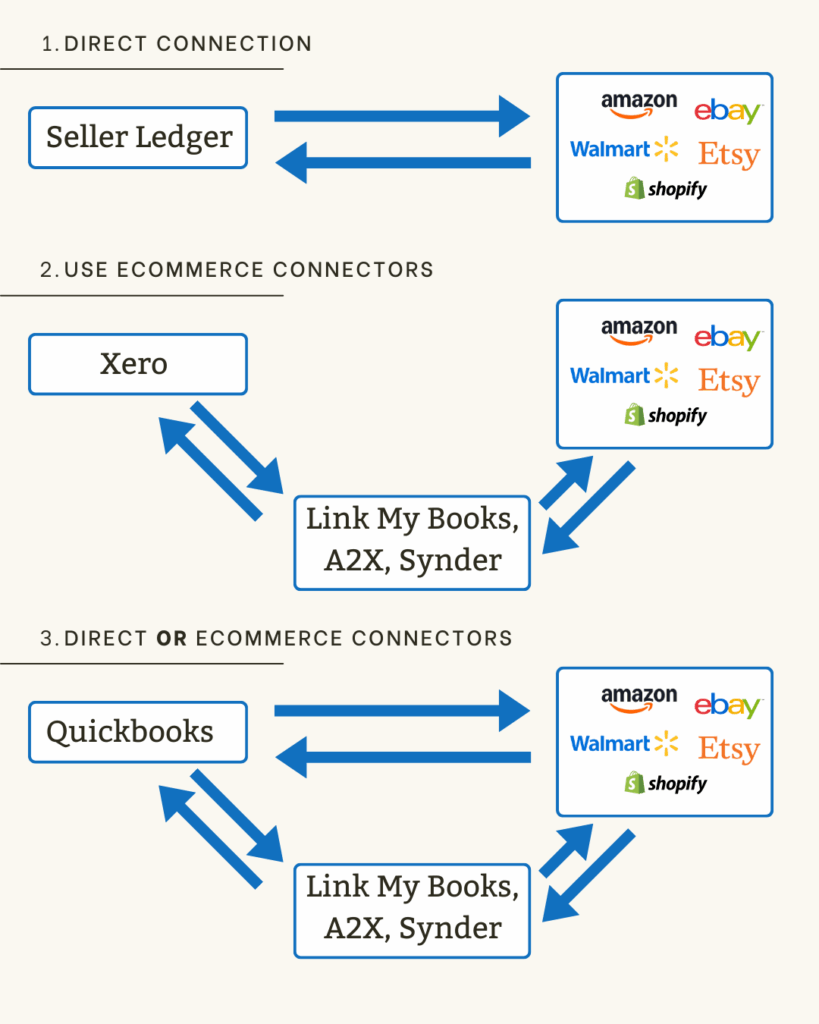
Let’s talk about some of the advantages and disadvantages of each option:
Direct connection
A direct connection means that not only has an accounting platform built their own access to marketplace data, but they have also taken the time to classify that information into the proper accounts, categories and tax lines that a business needs. Seller Ledger uses this approach.
Pros
Simplicity: Fewer moving parts means less work getting set up. And the connections and data are built into the core parts of the accounting software.
Lower costs: You don’t have to pay for extra software subscriptions.
Accountability: When marketplaces change their data, or introduce new fees, there’s only one party responsible for updating the software.
Cons
Less flexible: If your accounting needs are more unique, having the ability to choose between different methods of data connection (e.g. detailed vs summary) could be valuable.
3rd Party eCommerce connectors
Using 3rd party eCommerce connectors basically means an accounting platform is outsourcing the eCommerce data collection and classification to someone else. These 3rd parties specialize in eCommerce connectivity, so it’s a legitimate way to delegate responsibility. Xero has taken this approach.
Pros
Expertise of 3rd party connectors: The leading providers have been working with eCommerce Marketplaces for year, and are very familiar with the data.
Keeps books “clean and lean”: By delegating the task of collecting and summarizing eCommerce data, you can reduce the likelihood that your traditional accounting software gets bogged down by data it was never designed to handle.
Cons
Complexity: By using what some call “middleware”, you will have more setup to get things working as desired. And because the eCommerce connections are not baked into the core product, the user experience may feel disjointed.
Cost: Needing to use a separate software system will invariably cost more.
Choice of Direct OR 3rd part connectors
Then there’s the option for maximum flexibility. Some accounting platforms build their own direct connections to leading eCommerce marketplaces, but also allow you to choose a 3rd party connection instead. Quickbooks offers this choice.
Pros
Flexibility: You can choose which option works best for your business, even doing it on a marketplace by marketplace basis if so desired.
Experience: In the case of using 3rd party connectors, these tools have been used together for many years by many sellers.
Cons
Quality and coverage: Based on online commentary, there may be issues with how well the direct connection tools are managed. And Quickbooks, as of the time of this post, only provides a limited set of direct integrations (e.g. they don’t connect directly to Walmart.) As such, you could end up with a “kitchen sink” approach.
Complexity: Again, because the eCommerce connections are not a core part of the accounting software.
Cost: If you use a 3rd party connector in addition to a multi-channel tier of Quickbooks, prices could get up there.
Conclusion
As with any decision, your choice of accounting software to use for your eCommerce business comes down to the needs of your business and your personal preference. But, regardless of which option you choose, feel confident that there lots of ways to automate your eCommerce accounting using accounting software.