
INVENTORY TRACKING

Choose the right level of inventory tracking for your business.

Some sellers want simple bookkeeping. Others want detailed profit and inventory insights. Seller Ledger lets you choose how much tracking is worth the effort – from almost none to tracking every item.
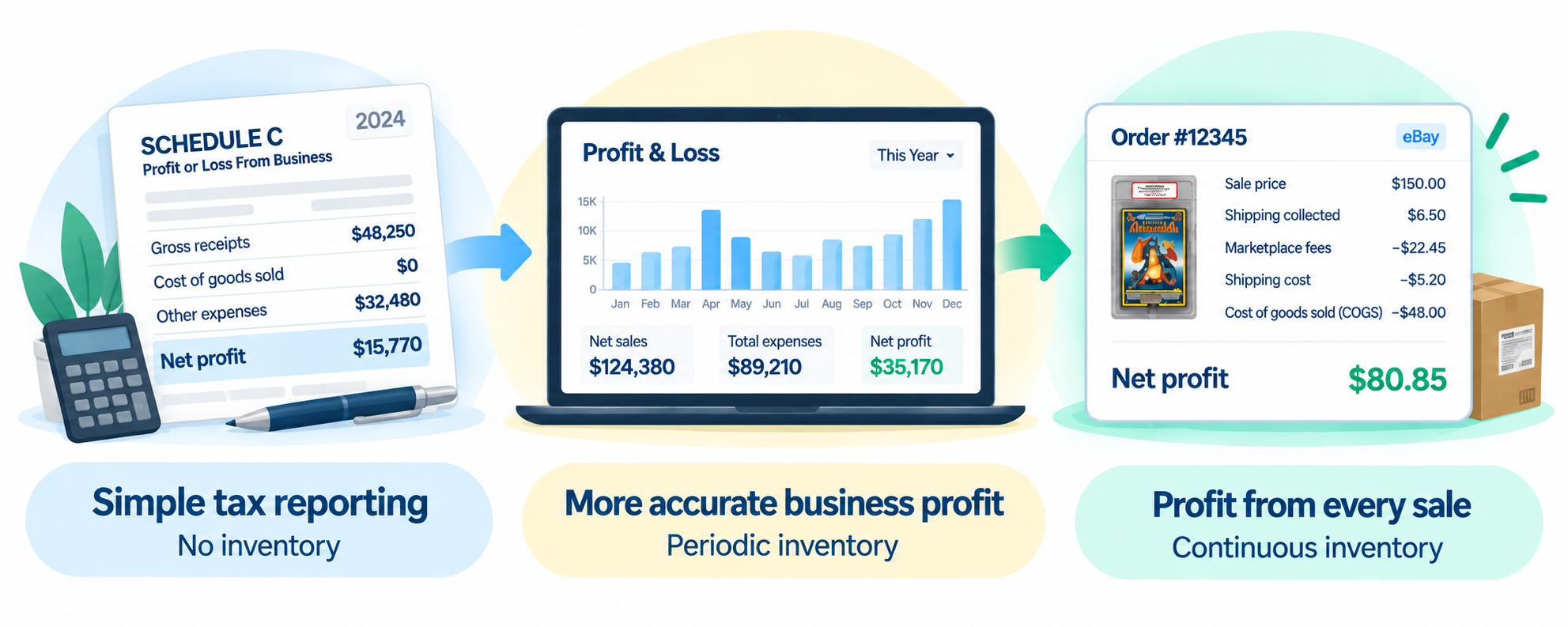
Inventory tracking options ranging from simple tax reporting to more accurate business profit and profit from every individual sale.
Less effort /
Less insight
More effort /
More insight

No inventory

Simple bookkeeping

Deduct the cost of your inventory purchases as an expense when you buy them, not when you sell them.

Very low

Just categorize your inventory purchases as Cost of Goods Sold. That’s it.

How profitable is my business? You can see revenue and expenses, but timing purchases rather than sales can make profit appear misleading.
×
How much did I make on this sale? You don’t know the item’s cost.
×
Which products make me the most money?
×
What is my inventory worth?
×
How long has an item been sitting?
×
How quickly is my inventory selling?

Periodic inventory

Track as little – or as much – as you want

Count the value of your unsold inventory periodically (even just once per year), and Seller Ledger calculates the adjustment to Cost of Goods Sold. You can also enter costs for some or most of your items if you want more detailed profit information.

You decide

Ranges from a simple annual count to tracking costs for nearly every item. Enter costs for the items where you want more detail and let your inventory count fill in whatever you missed.

How profitable is my business? Your inventory count lets Seller Ledger calculate a more accurate Cost of Goods Sold total.
How much did I make on this sale? Yes, for items where you’ve entered a cost.
Which products make me the most money? The more item costs you enter, the more complete this picture becomes.
What is my inventory worth? Yes — based on your most recent count.
×
How long has an item been sitting? Not reliably, since you’re not maintaining complete stock-level history.
×
How quickly is my inventory selling? Not reliably, since you’re not maintaining complete stock-level history.

Continuous inventory

Track every item

Enter the costs of the items you purchase (before or after a sale), and Seller Ledger automatically matches costs to sales and keeps your inventory up to date.

Highest

Enter or import the items you purchase and their costs, and make sure they can be matched when they sell.

How profitable is my business? Accurate and up to date.
How much did I make on this sale? Yes, automatically calculated.
Which products make me the most money? See profit by product, SKU and more.
Which channels are most profitable? See profit by sales channel.
What is my inventory worth? Updated as inventory changes.
What’s actually in stock right now? See current quantities on hand.
How long has an item been sitting? See inventory aging. COMING SOON.
How quickly is my inventory selling? See sales velocity and trends. COMING SOON.

You can always change your approach.

Start simple and add more detail later. You can switch inventory methods as your business grows.

More insight doesn’t mean a higher-priced plan.

Use any inventory method at any Seller Ledger price level. Your pricing is based only on your monthly transaction volume — not on how you choose to track inventory.

Learn how each method works

Dig into the details and decide which approach fits your business.